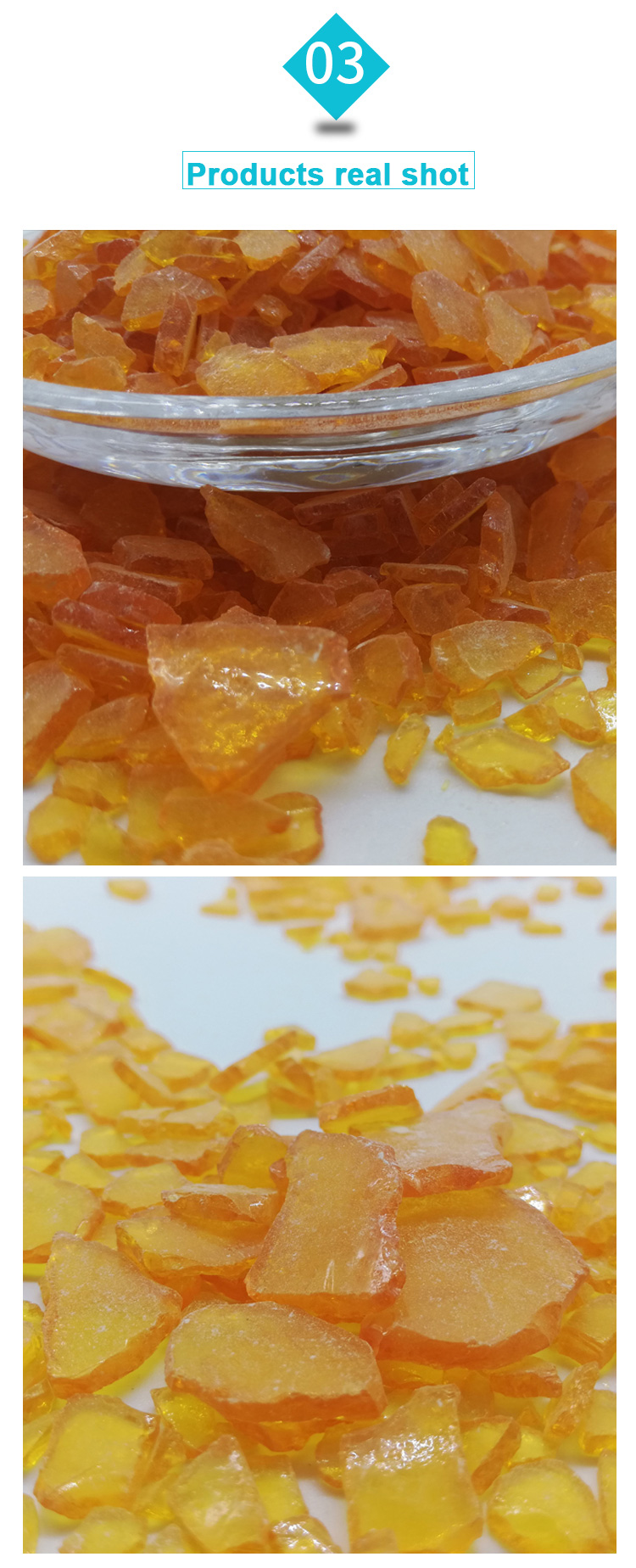
Phenolic resin has good heat resistance, flame resistance, water resistance and other properties
phenolic resin 551 is a thermally reactive alkylphenolic resin used in the synthesis of neoprene adhesives.Adhesives formulated with 551 have lower initial viscositier and excellent viscosity stability than comparable adhesives.Among neoprene adhesives,551 shows good bond strength at room temperature.
Phenolic resin is a kind of synthetic plastic, colorless or yellow-brown transparent solid. It is also commonly known as bakelite due to the use of electrical equipment. It has excellent heat resistance, flame resistance, water resistance and insulation, good acid resistance, poor alkali resistance, good mechanical and electrical properties, and easy to cut. It is divided into two categories: thermosetting plastics and thermoplastics. By adding different components during synthesis, modified phenolic resins with different functions can be obtained, which have different excellent properties, such as alkali resistance, abrasion resistance, oil resistance, corrosion resistance, etc.
Product indicators
| Exterior | Transparent irregular flakes or lumps |
| Proportion | 1.03 |
| Melting point ℉ | 170—195 |
| Softening Point ℃ | 100—110 |
| Color | 0—8 |
| Hydroxymethyl content % | 12—16 |
| Solubility | Aromatic; Aliphatic; Ketone; Esters; High Boiling Alcohol |
Applications
The main function of 551 is to make neoprene adhesives have a low initial viscosity and maintain viscosity stability. This type of adhesive relies on the interaction of elastomers and metal oxides to produce high cohesive strength at room temperature and high temperature. A typical recipe is as follows:
| Part A | Part B | ||
| Neoprene | 100.0 | 551 | 45.0 |
| Antioxidant | 1.0 | Water | 1.0 |
| Magnesium oxide | 8.0 | Solvent | 480.0 |
| Zinc oxide | 5.0 | ||
Part A - Preheat the roll of the thermal mill to 50°C, and add magnesium oxide, zinc oxide and antioxidants in sequence. Part B - Dissolve the resin in solvent and water. Part C - (After the resin is completely dissolved in the solvent) Mix Parts A and B and stir until the solution is homogeneous and single.
Adding a portion of water helps optimize viscosity stability without significantly affecting bond strength at elevated temperatures. Adding more water can continue to improve viscosity stability, but will greatly reduce the cohesive strength at high temperatures. A solvent system consisting of equal weights of toluene, n-ethane and methyl ethyl ketone (MEK) gives the adhesive a low initial viscosity and good stability.
- Parameters
Phenolic resin is a kind of synthetic plastic, colorless or yellow-brown transparent solid. It is also commonly known as bakelite due to the use of electrical equipment. It has excellent heat resistance, flame resistance, water resistance and insulation, good acid resistance, poor alkali resistance, good mechanical and electrical properties, and easy to cut. It is divided into two categories: thermosetting plastics and thermoplastics. By adding different components during synthesis, modified phenolic resins with different functions can be obtained, which have different excellent properties, such as alkali resistance, abrasion resistance, oil resistance, corrosion resistance, etc.
Product indicators
| Exterior | Transparent irregular flakes or lumps |
| Proportion | 1.03 |
| Melting point ℉ | 170—195 |
| Softening Point ℃ | 100—110 |
| Color | 0—8 |
| Hydroxymethyl content % | 12—16 |
| Solubility | Aromatic; Aliphatic; Ketone; Esters; High Boiling Alcohol |
Applications
The main function of 551 is to make neoprene adhesives have a low initial viscosity and maintain viscosity stability. This type of adhesive relies on the interaction of elastomers and metal oxides to produce high cohesive strength at room temperature and high temperature. A typical recipe is as follows:
| Part A | Part B | ||
| Neoprene | 100.0 | 551 | 45.0 |
| Antioxidant | 1.0 | Water | 1.0 |
| Magnesium oxide | 8.0 | Solvent | 480.0 |
| Zinc oxide | 5.0 | ||
Part A - Preheat the roll of the thermal mill to 50°C, and add magnesium oxide, zinc oxide and antioxidants in sequence. Part B - Dissolve the resin in solvent and water. Part C - (After the resin is completely dissolved in the solvent) Mix Parts A and B and stir until the solution is homogeneous and single.
Adding a portion of water helps optimize viscosity stability without significantly affecting bond strength at elevated temperatures. Adding more water can continue to improve viscosity stability, but will greatly reduce the cohesive strength at high temperatures. A solvent system consisting of equal weights of toluene, n-ethane and methyl ethyl ketone (MEK) gives the adhesive a low initial viscosity and good stability.





Previous : Phenolic resin DA-21 is used in addition to chloroprene adhesives, hot melt adhesives, etc.
Next : Modified phenolic resin used as vulcanizing agent for neoprene adhesives and butyl rubber


 Copy product links
 Long by picture save/share
INQUIRY


Add Successfully
At vero eos et accusamus et iusto elity agnissmos ducimus os quidtiis praesetium ptatum mole deeniti .
GET IN TOUCH

Address: M18-101, chemical zone, China south city, , shenzhen city, guangdong province, China.

Tell : (+86) 755-88834518
(Monday to Friday: 9:00-18:00)

Email : tanya@jitian168.com

Email : resin@jitian168.com
BUSINESS HOURS
Monday to Friday : 9 am to 6 pm
Saturday : 10 am to 4 pm
Sunday : Closed Support Hours in 24/7 Everyday
NEWS LETTER
Enter your email address for our mailing list to keep your self our lastest updated.

点击右上角
分享给朋友吧
© 2022 SHENZHEN JITIAN CHEMICAL CO.,LTD . All rights reserved Site Map